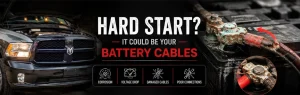
Your Ford starts perfectly one morning, then cranks slowly the next.
You check the battery. Maybe it tests good. You may even replace it, only to find that the truck still isn’t starting the way it should.
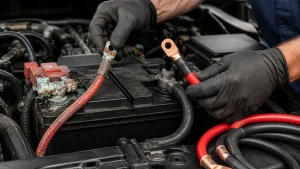
Before replacing the starter or another expensive electrical component, take a close look at the Ford truck battery cables.
Battery cables carry a tremendous amount of current during engine starting. On Ford Super Duty trucks with Power Stroke diesel engines, that demand can be especially high. Years of engine heat, vibration, moisture, corrosion, and repeated high-current starts can eventually take their toll on the cable and its connections.
And here’s something that catches many owners off guard: a battery cable can look perfectly acceptable on the outside and still have excessive resistance inside.
Quick Answer: When Should You Replace Ford Battery Cables?
You should inspect or consider replacing your Ford battery cables when you notice slow cranking, hard starting, heavy corrosion, damaged insulation, loose connections, excessive voltage drop, or intermittent electrical problems.
A good battery doesn’t guarantee a good starting circuit. The battery, cables, terminals, starter, alternator, and engine grounds all have to work together.
1. Your Ford Is Cranking Slowly
Slow cranking is one of the first things I’d check when a Ford truck doesn’t sound right during startup.
You turn the key or press the start button, and instead of the starter spinning the engine strongly, it sounds slow and labored.
It’s easy to blame the battery. Sometimes that’s correct. But don’t stop there.
The battery may have enough power while the cable delivering that power to the starter has too much resistance. A damaged, undersized, corroded, or loose cable can cause voltage loss before the current reaches the starter.
What should you inspect?
Check the complete starting circuit:
- Positive battery cable
- Negative battery cable
- Battery terminals
- Starter cable connection
- Engine ground
- Chassis ground
- Cable connections at both ends
Expert Tip from Custom Battery Cables: Don’t rely only on a visual inspection. If the battery tests good but the truck still cranks slowly, a voltage-drop test under load can help locate resistance that isn’t obvious by looking at the cable.
2. You See Corrosion or Damage Around the Cable Ends
Take a close look at the battery terminals and cable ends.
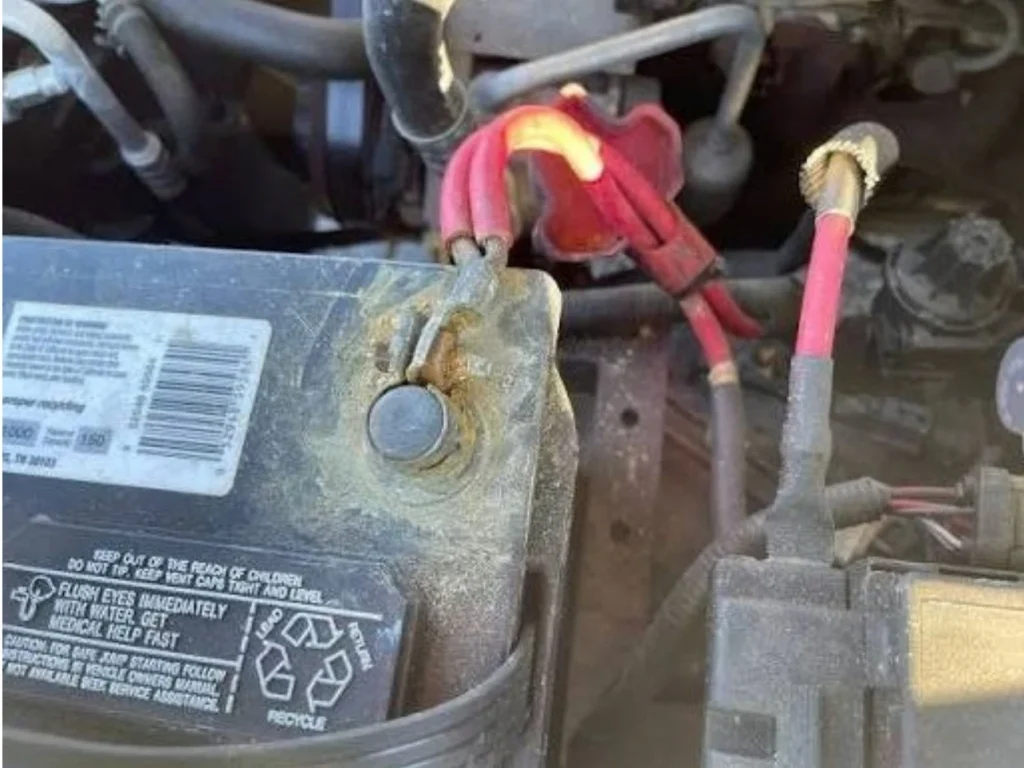
White, green, or powdery buildup is a warning sign. So are cracked insulation, swollen cable jackets, loose terminals, or discoloration from excessive heat.
A small amount of surface corrosion doesn’t automatically mean the entire cable has failed. The problem is when corrosion gets into the cable or the connection between the conductor and terminal.
At that point, cleaning the outside may only hide the problem temporarily.
This is especially important on older Ford trucks that have spent years around moisture, road salt, dirt, and engine heat.
Don’t just clean it and forget about it
If corrosion keeps returning or the cable end is physically damaged, replacement may be the better option.
A clean-looking terminal isn’t much help if the connection underneath has already deteriorated.
3. Your Ford Has Intermittent Starting or Electrical Problems
Intermittent problems are frustrating because the truck can appear completely normal one minute and refuse to cooperate the next.
Maybe it starts fine on Monday but only clicks on Tuesday.
A loose terminal, damaged cable, poor ground, or internal corrosion can create an inconsistent electrical connection.
You may notice:
- Occasional no-start conditions
- Clicking when starting
- Headlights dimming during cranking
- Strange dashboard behavior
- Accessories briefly losing power
- Battery warning lights appearing intermittently
These symptoms don’t automatically prove that the battery cables are bad. The battery, starter, alternator, and other components still need proper testing.
But don’t leave the cables out of the diagnosis simply because they don’t look terrible.
4. The Battery Tests Good but Your Ford Still Has Hard-Starting Problems
This is where replacing parts without diagnosing the problem can get expensive.
Let’s say your battery passes testing. Maybe the alternator checks out too. Yet your Ford still struggles to crank.
That’s when I’d pay closer attention to voltage drop.
A cable doesn’t have to be visibly damaged to have excessive resistance. And the higher the current demand, the more important that resistance becomes.
This matters even more with Power Stroke battery cables, because a diesel engine places substantial demands on the starting circuit.
Think about the complete electrical path:
Battery → Positive Cable → Starter → Engine/Chassis Ground → Battery
Every connection along that path matters.
Don’t overlook the ground side
The negative side of the circuit is just as important as the positive side.
A corroded or damaged ground cable can produce symptoms that look like a bad positive cable, weak battery, or failing starter.
Vincent’s Tip: When diagnosing a Ford hard-starting problem, inspect both sides of the starting circuit. A good positive cable can’t compensate for a poor ground connection.
5. Your Battery Cables Are Old, Heat-Damaged, or Deteriorated
There isn’t a universal mileage number that tells you when a battery cable must be replaced.
Cable life depends on its construction, routing, environment, temperature, vibration, and how the truck is used. A work truck that regularly tows, hauls, idles, or operates in harsh conditions can put more stress on its electrical system than a lightly used pickup.
Inspect older cables for:
- Brittle insulation
- Cracks
- Fraying
- Swelling
- Heat discoloration
- Corroded terminals
- Broken strands
- Loose connections
- Unusually stiff sections
If you see obvious physical damage, don’t wait for the truck to leave you stranded.
When Should You Replace Ford Truck Battery Cables?
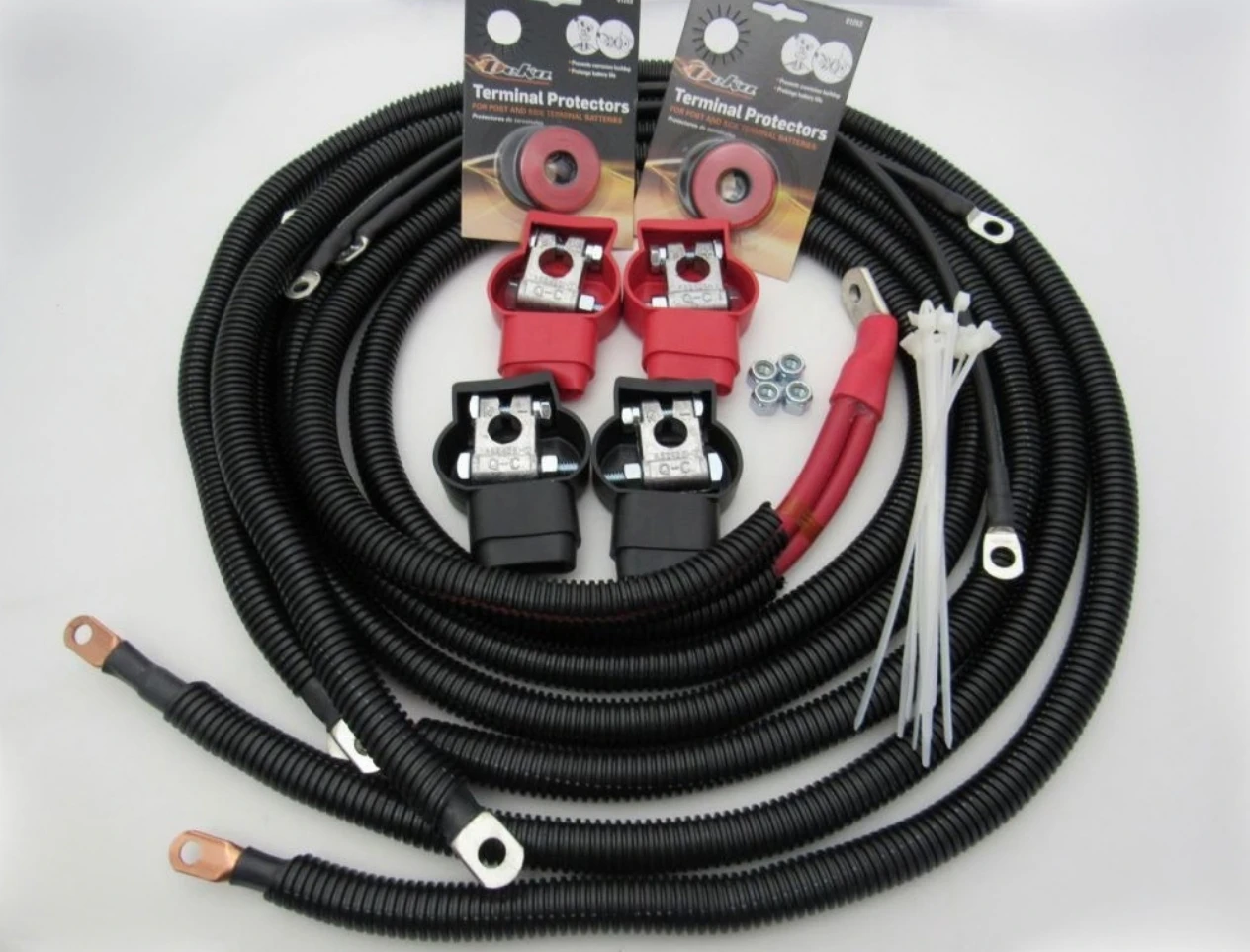
There’s no single replacement interval that applies to every Ford.
Instead, look at the cable’s condition and test results.
Replacement should be considered when:
- The cable has severe corrosion.
- Insulation is cracked or damaged.
- A terminal is loose or damaged.
- A voltage-drop test shows excessive loss.
- The cable shows heat damage.
- The conductor has deteriorated.
- Starting problems continue after the battery has been properly tested.
- You’re upgrading the truck for heavier electrical demands.
Sometimes you only need to replace one damaged cable. Other situations call for replacing several cables as a matched system.
Expert Tip from Custom Battery Cables
Vincent Eminowicz: When diagnosing a Ford starting problem, don’t check only the battery. Inspect both battery cables, the starter connection, and the engine and chassis grounds. If the battery tests good but the truck still cranks slowly, a voltage-drop test can help identify resistance that isn’t obvious from a visual inspection.
Ford F-250 and F-350 Owners: Check the Entire Cable System
Ford F-250 and F-350 trucks, particularly Power Stroke diesel models, place substantial demands on their starting and charging systems.
If your truck regularly tows, hauls, plows snow, operates a winch, or runs additional electrical equipment, cable condition deserves extra attention.
When ordering Ford F250 battery cables or Ford F350 battery cables, don’t choose a cable based only on the truck name.
Confirm:
- Model year
- Engine
- Cable gauge
- Cable length
- Terminal configuration
- Cable routing
- Electrical requirements
The correct cable needs to fit the actual application.
For vehicle-specific options, see our Ford Battery Cables.
Replace or Upgrade Your Ford Battery Cables?
Replacement and upgrading aren’t necessarily the same thing.
If an existing cable is damaged or failing, the first priority is to replace it with a properly specified cable.
An upgrade makes more sense when you’re replacing an aging system and want a heavier-duty setup appropriate for how the truck is actually used.
For example, a Ford that spends most of its time commuting doesn’t necessarily have the same electrical demands as an F-350 that regularly tows heavy loads.
A simple way to think about it
Replace: The original cable is damaged, corroded, deteriorated, or failing a voltage-drop test.
Upgrade: You’re replacing the cable system and want a more robust configuration suited to demanding use.
Expert Tip from Custom Battery Cables: Don’t select a cable simply because it has the largest gauge available. Cable size, length, terminal quality, routing, conductor construction, and grounding all matter.
Common Mistakes Ford Owners Make
Replacing the Battery First
A new battery won’t repair a bad cable connection.
Test the battery and inspect the cable system before spending money on another battery.
Checking Only the Positive Cable
The negative cable and engine grounds complete the starting circuit.
A poor ground can create the same frustrating symptoms as a damaged positive cable.
Judging the Cable by Appearance
A cable doesn’t have to look badly damaged to have excessive resistance.
Testing under load gives you better information.
Ignoring the Connections
Sometimes the cable is fine and the actual problem is a loose or corroded connection.
Check both ends before replacing the cable.
Simple Battery Cable Maintenance
A few minutes of inspection can prevent a much bigger headache later.
Every few months, look over the battery and cable connections for:
- Corrosion
- Loose terminals
- Cracked insulation
- Heat damage
- Frayed sections
- Poor ground connections
Keep the battery area clean and dry. Make sure cables are routed away from excessive engine or exhaust heat.
If something looks wrong, investigate it rather than waiting for a no-start condition.
A Real-World Ford Example
Consider an F-350 Power Stroke that has gradually started cranking slower.
The owner replaces the battery, but the truck still struggles.
The next suspect is the starter.
Before replacing it, the cable system is checked. Testing reveals excessive voltage loss through an aging battery cable connection.
In this situation, the starter wasn’t necessarily the original problem. The electrical path supplying it was.
That’s why proper diagnosis matters.
From the Shop: What We Look At First
Vincent Eminowicz — Founder & Owner, Custom Battery Cables LLC
When you’re dealing with a hard-starting truck, don’t immediately start replacing expensive components.
Start with the basics.
Look at the battery terminals. Inspect the positive and negative cables. Check the engine and chassis grounds. Look for corrosion and heat damage. If necessary, test voltage drop while the system is under load.
The goal isn’t to sell you the biggest cable possible. The goal is to identify what the truck actually needs and build or replace the cable accordingly.
For Ford owners who need an application-specific replacement, you can also review our individual Ford cables or Ford battery cable kits.
If your application is unusual or you need a specific length or terminal configuration, a custom battery cable may be another option.
Final Thoughts
Ford battery cable problems can easily look like battery, starter, or charging-system problems.
That’s why they’re often overlooked.
If your Ford is hard starting, cranking slowly, showing corrosion, developing intermittent electrical issues, or has visibly damaged cables, inspect the complete electrical path before replacing expensive components.
For Ford F250 battery cables, Ford F350 battery cables, and Power Stroke battery cables, proper application and fitment matter just as much as cable size.
A quality Ford battery cable replacement should match the truck’s year, engine, cable length, terminals, routing, and electrical requirements.
The best approach is simple:
Inspect first. Test when necessary. Replace or upgrade based on what the truck actually needs.
If your Ford truck isn’t starting as strongly as it used to, don’t overlook the cables. They may be a much bigger part of the problem than they appear.
About the Author
Vincent Eminowicz
Founder & Owner, Custom Battery Cables LLC
Vincent Eminowicz founded Custom Battery Cables in 2003 after gaining hands-on experience with heavy equipment, automotive electrical systems, and electronics. Today, he focuses on building made-to-order battery cables for cars, trucks, equipment, and other demanding applications, with an emphasis on proper fit, quality construction, and solving the customer’s actual electrical problem.