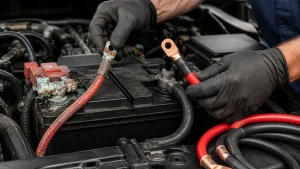
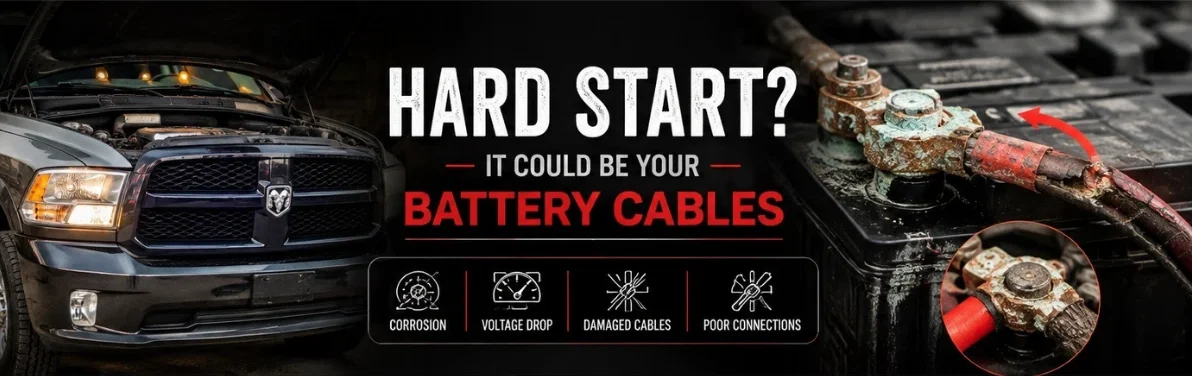
If your Dodge Ram takes longer than usual to start, cranks slowly, or sometimes sounds like the battery is too weak to do its job, don’t assume the battery is the problem.
Take a close look at the battery cables.
On Dodge Ram trucks, especially older 5.9L and 6.7L Cummins models, the starter needs a lot of current to crank the engine. If a cable is corroded, damaged, undersized, loose, or deteriorated inside, it can add resistance to the starting circuit.
That resistance creates voltage drop between the battery and starter.
Before you replace the battery, starter, or alternator, spend a few minutes checking the cables and their connections. You may find the problem there.
Quick Answer: Why Is Your Dodge Ram Hard to Start?
There are several possible reasons a Dodge Ram may be hard to start. A weak battery, failing starter, poor battery connections, engine or fuel-system problems, and excessive resistance in the battery cables or grounds can all cause starting trouble.
If the battery tests good but the engine still cranks slowly, don’t overlook the cables.
A voltage-drop test while the engine is cranking can reveal resistance that isn’t obvious during a basic visual inspection.
Common Battery Cable Problems on a Dodge Ram
Battery cables live in a tough environment. They deal with engine heat, vibration, dirt, moisture, and repeated high-current starting cycles. Eventually, problems can show up.
1. Corrosion at the Battery Terminals
Corrosion around a battery terminal is one of the first things you should check.
The cable can look perfectly fine from the outside while corrosion is developing between the terminal and the cable connection. That corrosion adds resistance and can interfere with current flow.
Look for:
- White, blue, green, or powdery buildup
- Loose battery terminals
- Damaged terminal hardware
- Discolored cable ends
- Cracked insulation around the terminal
Cleaning the outside of the terminal doesn’t necessarily mean you’ve fixed the cable. If corrosion has moved into the connection itself, the cable may still have a problem.
2. Damaged or Deteriorated Cable
Battery cables can also deteriorate internally. That’s why a cable can look acceptable on the outside and still perform poorly.
Years of heat, vibration, moisture, and heavy current can take their toll.
Check for cables that are:
- Swollen
- Brittle
- Cracked
- Frayed
- Stiff
- Discolored
- Physically damaged
If the conductor inside the cable has deteriorated, cleaning the terminal won’t solve the underlying problem.
3. Excessive Voltage Drop
Voltage-drop testing is one of the most useful ways to track down a starting-circuit problem.
Simply checking battery voltage with the engine off doesn’t tell you everything. A cable can have a resistance problem that only becomes obvious when the starter is pulling a large amount of current.
That’s why the circuit needs to be tested under load.
During cranking, a digital multimeter can be used to check voltage loss across both the positive and negative sides of the starter circuit.
Excessive resistance in the starter circuit can contribute to slow or intermittent cranking, which is why testing while the starter is operating is so useful.
4. Weak Ground Connections
Don’t concentrate only on the positive cable.
The ground side is just as important.
The starter needs a complete electrical path. A poor connection between the battery negative terminal, engine block, or chassis can restrict current just as effectively as a problem on the positive side.
Check:
- Battery negative connection
- Engine ground
- Chassis ground
- Ground cable ends
- Connection points for corrosion
- Loose or damaged fasteners
A ground strap can look fine and still have a poor electrical connection.
How to Perform a Basic Voltage-Drop Check
If you have a digital multimeter, you can perform a basic voltage-drop test on the starting circuit.
Check the Positive Side
Connect one meter lead to the battery positive post and the other to the starter’s positive terminal.
Now crank the engine.
You’re measuring how much voltage is being lost between the battery and starter.
A higher-than-expected reading points to resistance somewhere along that path, which could be in the cable, terminal, connection, or another part of the circuit.
Check the Negative Side
Next, check the ground side.
Place one probe on the battery negative post and the other on the starter housing or an appropriate engine ground point.
Crank the engine again.
This test helps identify resistance in the negative side of the starting circuit.
Voltage-drop testing is especially useful because you’re checking the circuit while current is actually flowing, rather than measuring resistance in an inactive circuit.
What Does a Bad Battery Cable Feel Like?
Truck owners don’t usually describe electrical problems in technical terms. They simply know the truck isn’t starting the way it should.
You might notice:
- Slow cranking
- A single click
- Repeated clicking
- Intermittent starting
- The truck starts normally one day and struggles the next
- Electrical accessories behave strangely while starting
- The battery appears charged, but the starter still turns slowly
None of these symptoms automatically proves the cable is bad.
They simply tell you that the starting system needs to be checked.
Don’t Automatically Blame the Battery
Replacing the battery is an easy first reaction when a truck starts slowly.
Sometimes the battery really is failing.
But if the battery is relatively new and passes the appropriate tests, installing another battery may not solve anything.
The starter needs a large amount of current.
The battery cables provide the path for that current.
If there’s too much resistance in that path, the starter may not receive the power it needs to crank the engine properly.
That’s why testing is better than guessing.
When Should You Replace Dodge Ram Battery Cables?
Battery cable replacement makes sense when you find:
- Severe corrosion
- Damaged insulation
- Broken or loose terminals
- Excessive voltage drop
- Heat damage
- Internal cable deterioration
- Repeated starting problems with a known-good battery
You should also consider replacement when the existing cables are simply old and showing clear signs of wear.
If the truck spends its time towing, working, off-roading, or operating in cold weather, a heavy-duty cable upgrade may also be worth considering.
Fix Hard Start Dodge Ram Battery cables– Upgrade Battery Cables
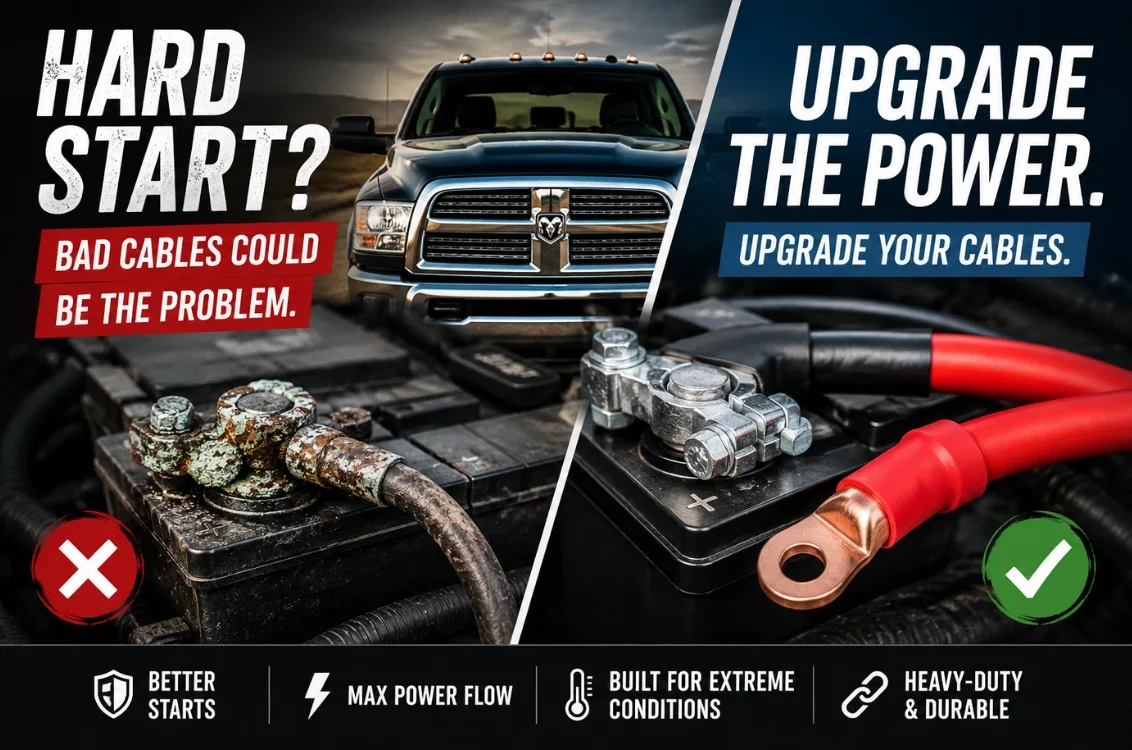
2/0 vs 3/0 Battery Cable for a Cummins
A common question from Dodge Ram owners is whether they should use 2/0 or 3/0 cable.
There’s no single answer that applies to every truck.
A 2/0 cable is already a heavy-duty option and can be an excellent choice for many applications.
A 3/0 setup takes things another step further and can make sense when maximum starting performance is the priority.
Custom Battery Cables offers both 2/0 and 3/0 Dodge Ram/Cummins options for several generations, including 5.9L and 6.7L applications.
For example, the 2003–2007 5.9L Cummins lineup includes a 2/0 cable kit as well as a 3/0 hard-start option. The 3/0 version uses a larger 3/0 positive battery-to-starter cable. Dodge RAM Gen 3, 2500/3500 Cummins Diesel I6 5.9L, 2003-2007, 2/0 Kit – Custom Battery Cables
When Does a 3/0 Hard-Start Cable Make Sense?
A larger cable can be especially useful for trucks that regularly operate in demanding conditions, such as:
- Very cold weather
- Heavy-duty applications
- Snowplow service
- High electrical-load conditions
- Frequent starting cycles
- Work or fleet environments
For these types of trucks, reducing resistance in the starting circuit can be an important part of building a reliable electrical system.
Dodge RAM Gen 3, 2500/3500 Cummins Diesel I6 5.9L, 2003-2007, 3/0 Hard Start Kit
Don’t Forget the Starter and Battery
Battery cables matter, but they’re only one part of the starting system.
A proper diagnosis should look at:
- Battery condition
- Battery state of charge
- Battery connections
- Positive cable voltage drop
- Ground-side voltage drop
- Starter condition
- Charging system
- Engine or fuel-related causes, where applicable
The goal is to find the actual problem instead of replacing parts one at a time and hoping something works.
Why Cable Size Matters
Think of the battery cable as the highway carrying electrical current from the battery to the starter and back through the ground circuit.
A larger conductor can reduce resistance in a high-current circuit.
But that doesn’t mean the biggest cable is automatically the right choice for every application.
Cable size, length, terminal type, routing, and the vehicle’s electrical requirements all matter.
For a high-current starting system, properly sized heavy-duty cable can make a meaningful difference when the original cable is undersized or has deteriorated over time.
A Realistic Troubleshooting Example
Let’s say you have a 2005 Dodge Ram 2500 with a 5.9L Cummins.
The truck starts slowly, so you install a new battery.
Nothing changes.
The starter tests reasonably well, and the battery terminals look clean.
At this point, many owners would start looking for another starter.
Before doing that, check the voltage drop.
If the positive side shows excessive voltage loss while the engine is cranking, the problem could be the cable, terminal, or connection between the battery and starter.
A simple test can point you toward the actual problem and potentially save you from replacing parts you didn’t need.
Should You Upgrade or Replace?
If the cables are damaged, replacement comes first.
If you’re already replacing old cables and want more current-carrying capacity, a heavy-duty upgrade may make sense.
For a Dodge Ram, don’t choose a cable based only on the words “Dodge Ram.”
Check the details:
- Model year
- Ram 1500, 2500, or 3500
- Engine
- Cummins generation
- Battery configuration
- Starter connection
- Required cable layout
Different applications can use different cable configurations, so fitment matters.
Final Takeaway
If your Dodge Ram is hard to start, don’t immediately assume the battery is bad.
Start with the basics.
Inspect the cables. Check the connections. Test voltage drop while the engine is cranking. Then decide whether the cable needs to be cleaned, repaired, replaced, or upgraded.
For an older Cummins, replacing worn factory cables with properly sized heavy-duty cables can be a practical way to improve the starting circuit.
The goal isn’t simply to install the biggest cable available. You want the right cable for the truck, the right length and terminals, and a solid installation that can handle the electrical demand.
If your Dodge Ram has been giving you hard-start trouble, check the cables before spending money on expensive parts.
Frequently Asked Questions
Can bad battery cables cause a Dodge Ram not to start?
Yes. Excessive resistance in the battery cable or ground circuit can interfere with the high-current path the starter needs.
How do I know if my Dodge Ram battery cable is bad?
Start by looking for corrosion, damaged insulation, loose connections, and physical deterioration. A voltage-drop test while cranking gives you a much better idea of whether the cable is creating excessive resistance.
Can a battery cable cause slow cranking?
Yes. Too much resistance in the starting circuit can reduce the amount of electrical power reaching the starter and contribute to slow cranking.
Should I choose 2/0 or 3/0 cable for my Cummins?
It depends on the truck and how you use it. A 2/0 cable is a heavy-duty option for many applications, while 3/0 can be a good choice when maximum starting performance is the goal.
Will new battery cables fix every hard-start problem?
No. Hard starting can also come from the battery, starter, charging system, or engine-related systems. Test the system before replacing parts.
Are Dodge Ram battery cables worth upgrading?
They can be. If the original cables are deteriorated, undersized for the application, or producing excessive voltage drop, a properly sized upgrade can be worthwhile.