Have you ever climbed into your Ford truck, turned the key, and heard nothing but a slow crank or a single click? Most drivers immediately assume the battery has failed. In many cases, however, the battery isn’t the real problem.
After working on Ford trucks for years, I’ve seen many owners replace batteries, starters, and even alternators only to discover that worn or damaged battery cables were causing the issue all along. Battery cables are responsible for delivering electrical power throughout your truck. When they become corroded, loose, or damaged, the entire electrical system suffers.
Whether you drive a Ford F-150, F-250, F-350, Ranger, Expedition, or a Power Stroke diesel, understanding how battery cables work can save you time, money, and unnecessary repairs.
Quick Answer
Common Ford battery cable problems include corrosion, loose connections, damaged insulation, worn ground cables, and internal cable corrosion. These issues restrict electrical current, causing hard starting, dim lights, charging problems, and poor overall electrical performance. Regular inspection and timely replacement help keep your Ford starting and charging reliably.
Why Battery Cables Matter
Battery cables are the pathway that carries electrical current between the battery, starter, alternator, and vehicle chassis.
The positive cable delivers power to the starter and electrical system while also carrying charging current back from the alternator. The negative cable grounds the electrical system and completes the circuit.
When either cable develops excessive electrical resistance, power cannot flow efficiently. The result is voltage drop, slower cranking, reduced charging efficiency, and extra stress on the battery and alternator.
Expert Tip: Before replacing your battery or alternator, inspect both battery cables and ground connections. A simple cable problem often creates the same symptoms as a failing battery.
Common Ford Battery Cable Problems
Most battery cable failures develop gradually due to age, heat, vibration, moisture, and road salt.
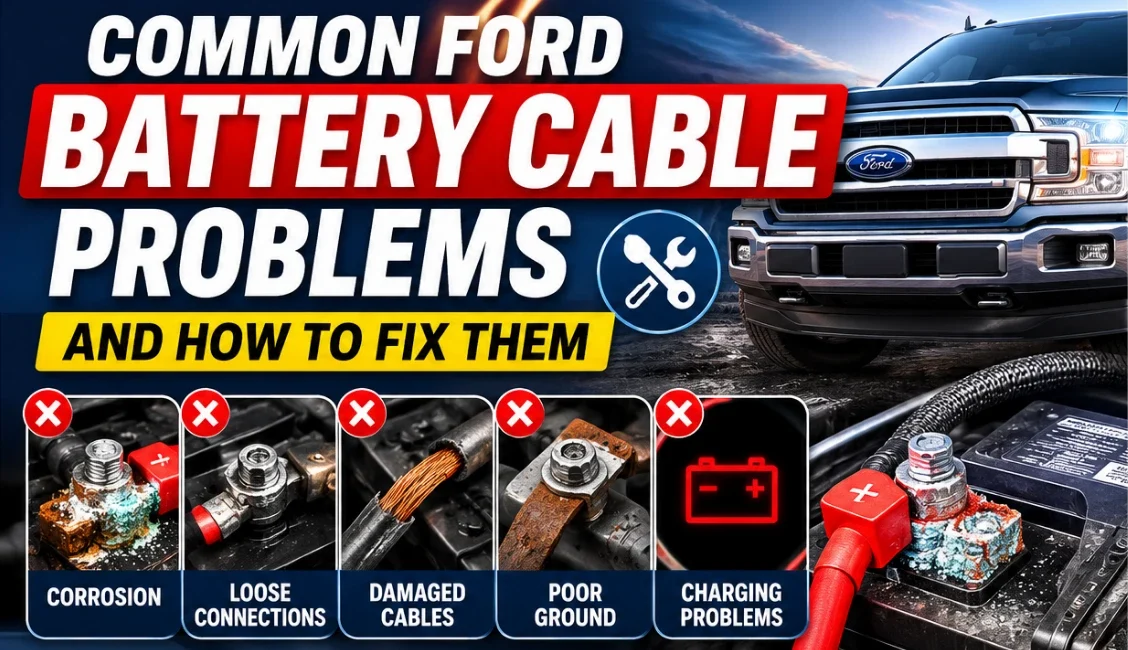
1. Battery Terminal Corrosion
White, green, or bluish corrosion around the battery terminals is one of the most common problems on Ford trucks. Corrosion increases electrical resistance, making it harder for the battery to deliver power.
Common Symptoms
- Hard starting
- Slow cranking
- Dim headlights
- Battery warning light
2. Loose Battery Connections
Loose battery terminals interrupt electrical current and often create intermittent problems that are difficult to diagnose.
Common Symptoms
- Random no-start conditions
- Clicking when turning the key
- Flickering dashboard lights
- Electrical accessories shutting off
3. Damaged or Aging Battery Cables
Battery cables naturally wear over time. Engine heat, vibration, and exposure to the elements can crack insulation or break internal copper strands.
Common Symptoms
- Slow engine cranking
- Low charging voltage
- Weak starter performance
- Hot battery cables
4. Internal Corrosion
Not all corrosion is visible. Moisture can enter damaged cables and slowly corrode the copper conductor inside the insulation.
This hidden corrosion reduces current flow and causes repeated charging problems even though the cable may appear normal from the outside.
5. Poor Ground Connections
Many Ford electrical problems are caused by worn or corroded ground cables.
A poor ground can lead to:
- Slow cranking
- Flickering lights
- Sensor faults
- Charging inconsistencies
- Intermittent electrical issues
Signs Your Ford Battery Cables Need Attention
Watch for these warning signs before they become major repairs.
- Hard starting
- Slow cranking
- Clicking when starting
- Dim headlights
- Battery warning light
- Battery repeatedly going dead
- Low charging voltage
- Hot battery cables
- Flickering electronics
- Burning electrical smell
If you notice several of these symptoms together, inspect the battery cables before replacing expensive components.
How to Fix Common Battery Cable Problems
Most battery cable problems are straightforward to diagnose and repair.
1. Clean Corroded Terminals
Disconnect the battery safely and clean corrosion using a battery terminal cleaner or a baking soda and water solution. Dry everything thoroughly before reconnecting.
2. Tighten Loose Connections
Ensure battery terminals are tight and ground bolts are secure. Loose connections create unnecessary electrical resistance.
3. Inspect Ground Straps
Check the battery-to-chassis and engine ground connections for rust, corrosion, or loose hardware.
4. Test for Voltage Drop
A voltage-drop test identifies excessive resistance that may not be visible during a simple inspection.
5. Replace Damaged Battery Cables
Replace cables if you notice:
- Cracked insulation
- Heavy corrosion
- Broken strands
- Melted insulation
- Swollen cable ends
Attempting temporary repairs often leads to recurring problems.
6. Upgrade When Necessary
If your truck regularly powers accessories such as winches, snowplows, trailer brakes, auxiliary lighting, or a high-output alternator, upgrading to heavy-duty copper battery cables can improve charging efficiency and reduce voltage loss.
OEM vs. Heavy-Duty Battery Cables (h3)
| Feature | OEM Cable | Heavy-Duty Custom Cable |
| Copper Quality | Standard | Premium Copper |
| Voltage Drop | Moderate | Lower |
| Heat Resistance | Standard | Excellent |
| Durability | Good | Excellent |
| Charging Efficiency | Good | Improved |
| Best Use | Daily Driving | Towing, Diesel, Off-Road |
| Long-Term Value | Moderate | Higher |
For stock daily drivers, OEM-quality replacement cables are usually sufficient. Trucks used for towing, off-roading, commercial work, or diesel applications often benefit from premium heavy-duty battery cables.
You might also like: Custom vs OEM Battery Cables: The Real Difference
Should You Upgrade?
A battery cable upgrade isn’t necessary for every Ford owner, but it can make sense if your truck works harder than average.
Heavy-duty battery cables are worth considering if you own:
- Ford F-150 used for towing
- Ford F-250 or F-350 work trucks
- Power Stroke diesel trucks
- Fleet vehicles
- Off-road trucks
- Winch-equipped vehicles
- Trucks with high-output alternators
- Vehicles with aftermarket audio systems
These applications place greater demand on the charging system, making lower-resistance cables a practical improvement.
Expert Tips
- Inspect battery cables during every oil change.
- Clean corrosion before it spreads.
- Replace damaged cables instead of repairing them.
- Don’t ignore ground connections.
- Use quality copper replacement cables whenever possible.
- Test the charging system before replacing the battery or alternator cables.
Common Mistakes to Avoid
Many expensive repairs begin with a simple diagnosis mistake.
Avoid these common errors:
- Replacing the battery before checking the cables.
- Ignoring corrosion around battery terminals.
- Installing undersized replacement cables.
- Buying low-quality aluminum cables.
- Forgetting to inspect ground straps.
- Leaving battery terminals loose after installation.
Buyer Checklist
Before purchasing replacement battery cables, ask yourself:
✔ Are the existing cables damaged?
✔ Do I tow heavy trailers?
✔ Does my truck have aftermarket accessories?
✔ Am I upgrading to a high-output alternator?
✔ Are my battery terminals heavily corroded?
If you answered “yes” to several of these questions, a quality heavy-duty battery cable upgrade may be a worthwhile investment.
Quick Problem & Solution Guide
| Problem | Symptoms | Recommended Fix |
| Corroded Terminals | Hard starting | Clean terminals |
| Loose Connection | Clicking noise | Tighten terminals |
| Damaged Cable | Slow crank | Replace cable |
| Internal Corrosion | Weak charging | Replace cable |
| Bad Ground | Electrical faults | Clean or replace ground |
| Voltage Drop | Dim lights | Perform voltage-drop test |
Final Thoughts
Battery cables may not receive much attention, but they play a vital role in your Ford’s starting and charging system. Corrosion, loose connections, worn insulation, and poor ground cables can all create symptoms that resemble a bad battery or failing alternator.
Before replacing expensive electrical components, inspect the battery cables, terminals, and ground connections carefully. Routine maintenance and timely replacement of worn cables can improve starting reliability, charging efficiency, and overall electrical performance.
Choosing high-quality replacement cables—especially for trucks used for towing, diesel applications, off-road driving, or commercial work—can help reduce voltage loss and support dependable performance for years to come. You can check the high-quality ford battery cables here.
A few minutes spent inspecting your battery cables today could save you from an unexpected no-start tomorrow.
Author

Vincent Eminowicz
Vincent Eminowicz is the Founder and Owner of Custom Battery Cables LLC. Since 2003, he has been dedicated to building high-quality custom battery cables, helping truck owners across the USA find durable, reliable electrical solutions at a fair price.