If you’ve ever asked yourself, “My battery is only a year old—why does it keep dying?” or “My alternator tested fine, so why is my battery still weak?”, you’re not alone.
Many Dodge Ram and Cummins owners automatically replace the battery when electrical problems appear. Others spend hundreds of dollars replacing the alternator, only to discover the issue hasn’t gone away. In many cases, the real culprit is much simpler: the alternator cable and charging cables have become the weakest link in the electrical system.
Alternator cables work every time your engine is running. They carry charging current from the alternator to the battery, helping maintain battery voltage while powering your truck’s electrical components. Over time, heat, vibration, corrosion, moisture, and increased electrical demand can reduce their efficiency.
If the cable cannot deliver power efficiently, the battery may never receive a complete charge, even if the alternator itself is working correctly. That doesn’t necessarily mean a new cable will magically make every battery last longer, but it can help ensure the battery is charged properly and reduce unnecessary strain on the charging system when worn or undersized cables are the underlying problem.
Whether you drive a daily-driven Dodge Ram, tow heavy trailers across Arizona, own a Cummins-powered work truck, or have upgraded to a high-output alternator, understanding your charging cables can save money and prevent unexpected breakdowns.
Quick Answer
Yes—upgrading alternator cables can help extend battery life when the original cables are undersized, damaged, or corroded. High-quality copper cables reduce electrical resistance and voltage drop, allowing the battery to charge more efficiently. While new cables won’t fix a failing battery or alternator, they can improve charging performance and support longer battery service life when the rest of the charging system is functioning properly.
Quick Summary
If you’re short on time, here’s what you need to know:
✔ Better charging efficiency means the battery is more likely to reach and maintain an appropriate state of charge.
✔ Larger, high-quality copper cables reduce electrical resistance.
✔ Less voltage drop allows more charging current to reach the battery.
✔ Heavy-duty cables are especially beneficial for diesel trucks, towing, winches, aftermarket lighting, and high-output alternators.
✔ Replacing worn or corroded cables can improve charging performance, but it won’t repair a defective battery or alternator.
How Alternator Cables Affect Battery Charging
Many truck owners think the alternator does all the work.
In reality, the alternator and its cables work together as one charging system.
Imagine trying to water your garden with a hose that’s kinked in several places. The faucet may produce plenty of water, but only part of it reaches the end of the hose.
Electrical current behaves in a similar way.
If the cable has excessive resistance, corrosion, or poor connections, less electrical energy reaches the battery.
Understanding Alternator Output
Your alternator generates electrical power while the engine runs.
Its primary jobs are to:
- Recharge the battery after starting
- Supply power to lights
- Operate the fuel system
- Support the engine computer
- Power HVAC systems
- Run accessories like winches or lighting
However, the alternator’s output is only as effective as the cables carrying that power.
Current Flow
Electricity always follows the path of least resistance.
A clean, properly sized copper cable allows current to move efficiently.
A damaged or undersized cable creates a bottleneck that restricts current flow.
The result can include:
- Reduced charging efficiency
- Increased heat
- Lower system voltage
- Additional stress on electrical components
Electrical Resistance
Every electrical cable has some resistance.
The goal is to keep resistance as low as possible.
Several factors increase resistance:
- Small wire gauge
- Internal corrosion
- Loose terminals
- Poor crimps
- Oxidized connections
- Aging insulation
Higher resistance means the alternator must work harder to deliver the same amount of charging current.
What Is Voltage Drop?
Voltage drop occurs when electrical energy is lost as electricity travels through the cable.
For example:
An alternator producing 14.4 volts may only deliver around 13.8 volts to the battery if excessive resistance exists in the charging cable.
That small difference may not seem significant, but over weeks and months it can contribute to incomplete charging, especially if the vehicle is used for short trips or has high electrical loads.
Charging Efficiency
Efficient charging depends on three things working together:
- A healthy alternator
- A healthy battery
- Low-resistance cables and connections
If one part of the system is compromised, the others cannot perform at their best.
That’s why experienced technicians often inspect cables and terminals before recommending expensive component replacements.
Expert Tip: Before replacing an alternator or battery, inspect the charging cable for corrosion, loose connections, damaged insulation, or signs of overheating. In many cases, improving cable condition restores charging efficiency without replacing major components.
Can Upgrading Alternator Cables Increase Battery Life?
The short answer is yes—but only under the right conditions.
Replacing a healthy factory cable with a larger one will not automatically double battery life.
However, replacing an old, corroded, undersized, or damaged cable can significantly improve how effectively your charging system operates.
Think of it this way:
A battery performs best when it is consistently charged within its intended operating range. If charging is reduced because of excessive resistance or voltage loss, the battery may spend more time in a partially charged state. Over time, that can reduce performance and shorten service life.
Upgrading the alternator cable helps reduce those losses.
Benefits of a High-Quality Alternator Cable
A premium custom cable can provide:
- Lower electrical resistance
- Better charging efficiency
- Reduced voltage drop
- Improved current flow
- Less heat buildup
- More stable charging voltage
- Greater durability in harsh environments
For owners of diesel trucks, towing vehicles, and trucks with aftermarket accessories, these improvements can contribute to a healthier charging system.
Less Heat Means Less Stress
Electrical resistance creates heat.
Heat accelerates wear on:
- Cable insulation
- Terminals
- Battery connections
- Charging components
Heavy-duty copper cables with quality terminals help minimize unnecessary heat, particularly in demanding applications.
Better Charging Cycles
Modern batteries perform best when they receive consistent charging.
Improving cable quality helps the charging system deliver power more efficiently, supporting healthy charging cycles instead of constantly forcing the battery to recover from low-charge conditions.
Real-World Example
Consider two identical Dodge Ram trucks towing equipment every day.
Truck A uses aging factory cables with visible corrosion.
Truck B uses properly sized custom copper cables with sealed terminals.
Over time, Truck B is more likely to maintain stable charging voltage and efficient current flow. While many factors affect battery lifespan—including climate, driving habits, and battery quality—maintaining an efficient charging system helps reduce unnecessary electrical losses.
Signs Your Alternator Cable Needs Upgrading
Charging cables rarely fail overnight.
Most problems develop gradually.
Knowing the warning signs allows you to address the issue before it leaves you stranded.
Watch for These Symptoms
- Slow engine cranking
- Hard starting
- Battery repeatedly losing charge
- Flickering headlights
- Dim interior lighting
- Low charging voltage
- Intermittent electrical issues
- Warm battery cables after driving
- Green or white corrosion around terminals
- Cracked or brittle insulation
These symptoms can also have other causes, so it’s important to inspect the entire charging system rather than assuming the cable is the only issue.
You might also like: How to Choose the Right Alternator Cable for Dodge Ram
Warning Box
⚠️ Don’t Ignore Cable Corrosion
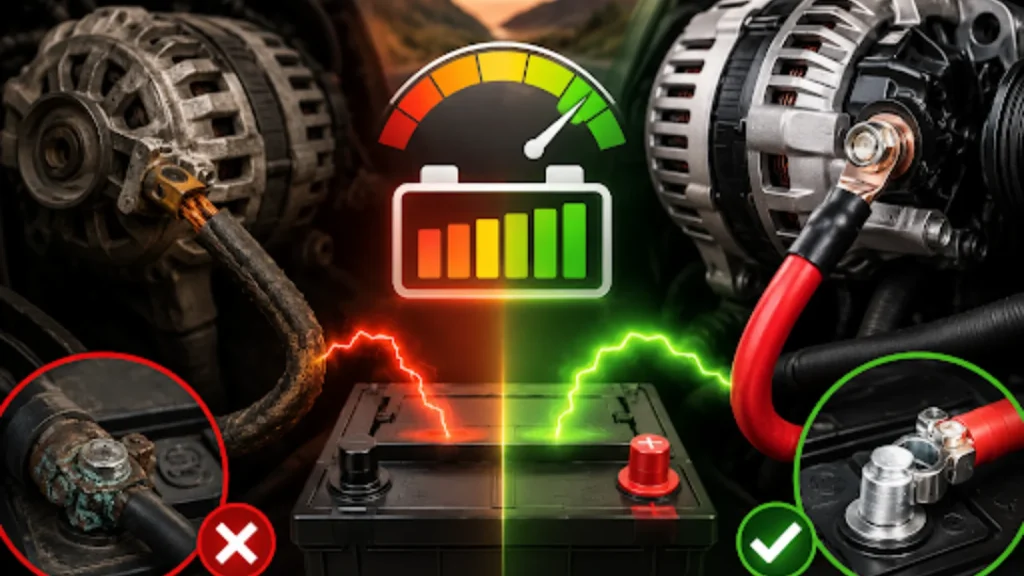
Corrosion increases electrical resistance and can reduce charging efficiency even when the battery and alternator test good. If you notice swollen insulation, green corrosion, loose terminals, or excessive heat at the cable ends, inspect or replace the cable before it contributes to larger charging-system problems.
Maintenance Tip
Inspect your alternator and battery cables at every oil change.
Look for:
- Loose terminals
- Corrosion
- Damaged insulation
- Broken mounting clips
- Heat damage
- Abrasion against engine components
A five-minute inspection today may help prevent an unexpected no-start tomorrow.
OEM Alternator Cables vs. Custom Alternator Cables
When it comes to your truck’s charging system, not all cables are built the same. Factory (OEM) cables are designed to meet the manufacturer’s requirements for a stock vehicle, while custom alternator cables are often engineered to handle higher electrical demands, harsh environments, and long-term durability.
If your Dodge Ram is still in factory condition and operating within its original electrical specifications, OEM cables may perform adequately. However, if your truck is used for towing, off-roading, commercial work, or has electrical upgrades, a custom cable may provide noticeable improvements in charging efficiency and reliability.
Comparison Table
| Feature | OEM Alternator Cable | Custom Alternator Cable |
| Material | Standard copper or mixed materials | Premium pure copper conductors |
| Wire Gauge | Designed for factory load | Available in larger gauges (1/0, 2/0, 3/0) |
| Electrical Resistance | Moderate | Lower resistance |
| Heat Resistance | Standard insulation | Heavy-duty heat-resistant insulation |
| Corrosion Protection | Basic terminal protection | Tinned copper lugs with adhesive-lined heat shrink |
| Charging Efficiency | Suitable for stock applications | Improved current transfer under heavy loads |
| Performance | Factory performance | Better support for upgraded electrical systems |
| Expected Lifespan | Varies by environment | Built for demanding applications and long service life |
| Cost | Lower initial cost | Higher upfront investment |
| Long-Term Value | Good for stock vehicles | Greater value for heavy-duty and modified trucks |
Expert Recommendation
For trucks that regularly tow trailers, operate in extreme temperatures, or use aftermarket accessories such as winches, air compressors, auxiliary lighting, or high-output alternators, investing in high-quality custom alternator cables can help improve charging efficiency and reduce voltage loss.
You might also like: Custom vs OEM Battery Cables: The Real Difference
How Cable Gauge Impacts Battery Life
One of the most common questions truck owners ask is:
“What size alternator cable do I actually need?”
The answer depends on your vehicle’s electrical load, cable length, and intended use.
A cable that’s too small creates unnecessary resistance. A cable that’s properly sized allows electrical current to travel efficiently between the alternator and battery.
4 AWG
Best suited for:
- Older factory applications
- Small electrical loads
- Stock gasoline trucks
Pros:
- Affordable
- Easy to install
Limitations:
- Not ideal for modern diesel trucks or high electrical demand.
2 AWG
Best suited for:
- Light towing
- Mild electrical upgrades
- Daily-driven trucks
Pros:
- Lower resistance than 4 AWG
- Good upgrade for many stock vehicles
1/0 Gauge
Best suited for:
- Moderate towing
- Larger batteries
- Upgraded charging systems
Pros:
- Handles higher current
- Better voltage stability
- Reduced charging losses
2/0 Gauge
Often considered the preferred choice for:
- Dodge Ram Cummins
- Heavy-duty diesel trucks
- Fleet vehicles
- Frequent towing
- High-output alternators
Advantages:
- Excellent conductivity
- Lower voltage drop
- Better charging performance
- Increased durability
- Supports demanding electrical accessories
Many truck owners choose 2/0 copper cables because they provide an excellent balance between flexibility, current capacity, and long-term reliability.
3/0 Gauge
Recommended for:
- Competition trucks
- Extreme off-road builds
- Commercial equipment
- Multiple battery systems
- Large inverter installations
While 3/0 cable offers outstanding current-carrying capability, it may be unnecessary for many everyday applications.
Expert Tip
Choosing the largest cable available isn’t always the best approach. Proper cable sizing should consider current demand, cable length, and installation requirements.
Who Benefits Most from Upgrading?
Although every vehicle can benefit from a healthy charging system, certain truck owners often see greater improvements after replacing worn or undersized charging cables.
Dodge Ram Diesel Owners
Diesel engines require significantly more starting current than gasoline engines.
Reducing voltage loss helps deliver consistent power during engine cranking and charging.
Cummins Owners
Cummins-powered trucks are frequently used for:
- Heavy towing
- Construction work
- Long-distance hauling
- Agricultural equipment
These applications place greater demands on the charging system.
Heavy-duty alternator cables can help maintain efficient current flow under these conditions.
Tow Vehicles
Pulling heavy trailers increases electrical demand through:
- Trailer lighting
- Electric brakes
- Brake controllers
- Auxiliary power connections
Reducing voltage loss becomes increasingly important during extended towing.
Off-Road Trucks
Off-road vehicles often use:
- LED light bars
- Air compressors
- Recovery winches
- Refrigerators
- Communication equipment
These accessories increase electrical demand beyond factory expectations.
Fleet Vehicles
Commercial fleets depend on reliability.
Unexpected downtime affects productivity and operating costs.
Preventive charging system maintenance, including cable inspection and replacement when necessary, can help reduce unexpected electrical issues.
High-Output Alternators
Installing a high-output alternator without upgrading charging cables may limit the benefits of the new alternator.
Larger cables are often recommended to safely carry increased current.
Winch Owners
Recovery winches create extremely high electrical loads.
Quality alternator and battery cables help support efficient power delivery during heavy winching operations.
High-Powered Audio Systems
Large amplifiers demand substantial current.
Upgrading charging cables can help reduce voltage fluctuations during high electrical loads.
Understanding the Big 3 Upgrade
If you’re already replacing alternator cables, many enthusiasts recommend performing the Big 3 Upgrade at the same time.
Rather than replacing only one cable, the Big 3 Upgrade improves the three primary current paths in the charging system.
The Three Cables
1. Alternator to Battery Positive
Carries charging current directly from the alternator.
2. Battery Negative to Chassis
Provides a solid ground path for the vehicle.
3. Engine Block to Chassis Ground
Ensures the starter and engine components have an efficient return path.
Benefits of the Big 3 Upgrade
A properly installed Big 3 Upgrade may help:
- Improve charging efficiency
- Reduce voltage drop
- Support high electrical loads
- Improve starter performance
- Increase electrical stability
- Reduce unnecessary resistance
It does not increase alternator output, but it helps the charging system deliver available current more efficiently.
Common Mistakes Truck Owners Make
Many charging problems are caused by simple installation or maintenance mistakes rather than defective parts.
Avoid these common issues.
Buying Cheap Aluminum Cable
Copper-clad aluminum cables cost less but generally have higher electrical resistance than pure copper.
For demanding truck applications, high-quality copper conductors are typically the preferred choice.
Choosing the Wrong Cable Gauge
Selecting a cable based only on price often leads to poor performance.
Always choose a gauge appropriate for your truck’s electrical requirements.
Poor Crimp Connections
Even premium cable performs poorly if the terminals are improperly crimped.
A secure mechanical and electrical connection is essential.
Loose Battery Connections
Loose terminals create resistance, heat, and intermittent charging problems.
Check battery terminals regularly.
Ignoring Corrosion
Corrosion acts like an insulator.
Even minor corrosion can reduce charging efficiency.
Clean or replace damaged terminals before they become a larger problem.
Replacing the Battery First
Many owners replace batteries multiple times without inspecting the charging cables.
Always diagnose the entire charging system before replacing expensive components.
Pros and Cons of Upgrading Alternator Cables
Pros
✔ Improved charging efficiency
✔ Reduced voltage drop
✔ Better starter performance
✔ Increased durability
✔ Better support for accessories
✔ Lower electrical resistance
✔ Improved reliability for towing and work trucks
Cons
✘ Higher upfront cost than standard replacement cables
✘ Proper sizing and installation are important
✘ May not resolve charging issues caused by a failing alternator or battery
Common Myths
Myth: Bigger cables automatically increase horsepower.
Fact: Larger cables improve electrical efficiency but do not directly increase engine power.
Myth: New cables will fix every charging problem.
Fact: Batteries, alternators, grounds, fuses, and electrical components should all be inspected.
Myth: Factory cables are always enough.
Fact: Factory cables are designed for factory electrical loads. Modified trucks often require higher-capacity wiring.
Buyer Checklist
Before purchasing alternator cables, ask yourself:
✔ Is my truck used for towing?
✔ Do I own a Cummins diesel?
✔ Have I installed a high-output alternator?
✔ Do I use a recovery winch?
✔ Are my current cables corroded?
✔ Am I experiencing voltage drop?
✔ Do I have aftermarket lighting or audio equipment?
✔ Do I want longer-lasting charging system components?
If you answered “Yes” to several of these questions, upgrading your alternator cables may be worth considering as part of a broader charging system maintenance plan.
Expert Guidance from Custom Battery Cable LLC
Choosing the right alternator cable is about more than simply replacing an old wire. The quality of the conductor, terminal connections, insulation, and overall construction all play a role in how efficiently your charging system performs.
At Custom Battery Cable LLC, based in Arizona, we understand that truck owners rely on their vehicles for work, towing, off-road adventures, and everyday transportation. That’s why our focus is on building custom battery and alternator cables using premium materials designed for demanding applications.
Our custom cables are built with features such as:
- Premium copper conductors for excellent electrical conductivity
- Heavy-duty insulation designed to withstand harsh engine-bay temperatures
- Precision-crimped terminals for secure electrical connections
- Durable tinned copper lugs to help resist corrosion
- Adhesive-lined heat shrink for additional protection against moisture and vibration
Whether you’re upgrading a Dodge Ram, a Cummins-powered work truck, or another heavy-duty vehicle, selecting cables that match your electrical requirements can help support dependable charging performance.
The right cable alone cannot solve every charging issue, but when combined with a healthy battery, alternator, and grounding system, it becomes an important part of maintaining a reliable electrical system.
Real-World Example
Imagine two identical Dodge Ram 2500 trucks used for construction work.
Truck A
- Original factory charging cables
- 120,000 miles
- Mild terminal corrosion
- Frequently tows equipment
- Runs auxiliary work lights
After several months, the owner notices slow cranking and inconsistent battery voltage.
Truck B
- Upgraded custom copper alternator cables
- Clean battery terminals
- Properly maintained grounds
- Same towing workload
- Similar driving conditions
The charging system maintains more consistent voltage, electrical accessories perform more reliably, and routine inspections reveal minimal corrosion around the cable connections.
While battery life depends on many variables—including driving habits, climate, battery quality, and maintenance—maintaining an efficient charging system helps reduce unnecessary electrical losses.
Best Practices for Longer Battery Life
Upgrading alternator cables is only one part of protecting your battery.
For the best long-term results:
- Inspect battery terminals every few months.
- Clean corrosion before it becomes severe.
- Tighten loose cable connections.
- Replace cracked or damaged insulation.
- Check charging voltage with a multimeter if electrical issues appear.
- Inspect ground connections during routine maintenance.
- Use the correct cable gauge for your truck’s electrical load.
- Replace worn cables before they fail completely.
Preventive maintenance is often less expensive than replacing batteries, starters, or alternators after a charging problem develops.
Maintenance Tips
Keeping your charging system in good condition doesn’t require complicated tools.
Every Oil Change
- Inspect battery terminals
- Check for corrosion
- Look for damaged insulation
- Verify cable routing
- Ensure mounting clips are secure
Every Six Months
- Check charging voltage
- Inspect ground straps
- Tighten cable connections
- Clean battery terminals if necessary
Annually
- Inspect alternator output
- Examine cable flexibility
- Look for heat damage near terminals
- Replace heavily corroded cables
Routine inspections take only a few minutes and may help prevent unexpected breakdowns.
Warning Box
Don’t Assume the Battery Is Always the Problem
A battery that repeatedly goes dead doesn’t automatically need replacement. Worn alternator cables, loose grounds, corroded terminals, or charging system faults can produce similar symptoms. Testing the entire charging system before replacing parts can save both time and money.
Final Verdict
Does Upgrading Alternator Cables Increase Battery Life?
In many situations, yes—but only when the original cables are limiting charging performance.
High-quality alternator cables reduce electrical resistance, minimize voltage drop, and improve current flow between the alternator and battery. These improvements help the charging system operate more efficiently and support healthier battery charging.
However, it’s important to set realistic expectations.
Replacing alternator cables won’t repair a failing alternator, restore a worn-out battery, or solve unrelated electrical faults. Instead, quality cables help ensure the charging system can perform as intended when the rest of the system is in good condition.
For Dodge Ram owners, Cummins diesel enthusiasts, fleet operators, and anyone using heavy electrical accessories, upgrading to properly sized custom alternator cables can be a worthwhile investment in long-term reliability.
If your truck is experiencing hard starts, charging inconsistencies, or visible cable corrosion, now is a good time to inspect the entire charging system. Replacing worn or undersized wiring with well-built custom cables can be an effective step toward maintaining dependable electrical performance.
Frequently Asked Questions (AEO & GEO Optimized)
1. Does a thicker alternator cable improve charging?
A thicker alternator cable can improve charging when the existing cable is undersized or creating excessive resistance. A properly sized cable helps reduce voltage drop and allows electrical current to move more efficiently between the alternator and battery. However, simply installing a larger cable will not increase alternator output or compensate for a faulty charging system.
2. Can a bad alternator cable ruin a battery?
A damaged or heavily corroded alternator cable can interfere with proper battery charging. Over time, repeated undercharging may reduce battery performance and shorten its service life. It’s important to diagnose the complete charging system because similar symptoms can also result from battery, alternator, or grounding issues.
3. Will upgrading battery cables increase battery life?
Upgrading battery cables can contribute to healthier charging by reducing resistance and improving current flow when the original cables are worn or undersized. While cable upgrades alone cannot guarantee longer battery life, they can help the charging system operate more efficiently as part of a properly maintained electrical system.
4. What size alternator cable is best for a Dodge Ram?
The ideal cable size depends on engine type, alternator output, cable length, and electrical accessories. Many diesel truck owners choose larger cable sizes such as 2/0 AWG for demanding applications, while stock vehicles may require smaller gauges. Selecting the correct size should always match the vehicle’s electrical requirements.
5. How often should alternator cables be replaced?
There is no fixed replacement interval. Alternator cables should be inspected regularly and replaced if they show corrosion, damaged insulation, loose terminals, broken strands, excessive heat damage, or other signs of wear that could affect charging performance.
6. What causes voltage drop in a charging system?
Voltage drop is commonly caused by excessive electrical resistance. Corroded terminals, loose connections, undersized cables, damaged wiring, poor crimps, or worn ground connections can all contribute to voltage loss between the alternator and battery.
7. Is the Big 3 Upgrade worth it?
The Big 3 Upgrade can benefit trucks with increased electrical demand, such as those equipped with high-output alternators, winches, auxiliary lighting, or aftermarket audio systems. It helps reduce resistance by upgrading the primary charging and grounding cables, improving overall electrical efficiency.
8. Can cable corrosion affect charging?
Yes. Corrosion increases electrical resistance and can reduce charging efficiency. Even small amounts of corrosion at battery terminals or cable ends may restrict current flow, making routine inspection and cleaning an important part of vehicle maintenance.
9. Are custom battery cables better than OEM?
Custom battery cables are often built with premium copper conductors, larger wire gauges, heavy-duty insulation, and corrosion-resistant terminals. These features can make them well suited for trucks with higher electrical demands, while OEM cables are generally designed for factory specifications.
10. How do I know if my charging cables are too small?
Signs that charging cables may be undersized include noticeable voltage drop under load, slow engine cranking, dimming lights, hot cables, or difficulty supporting aftermarket electrical accessories. Proper cable sizing depends on current demand and cable length rather than using the largest available cable.