Is your engine slow to crank? Are your interior lights dimming, or do your headlights flicker when you start the vehicle?
Many drivers immediately blame the battery. But the battery isn’t always the problem. Damaged, corroded, loose, or undersized battery cables can restrict electrical current and create symptoms that look very similar to a weak battery or failing starter.
If you’re wondering when to replace your car battery cables, start by inspecting the cables and connections before buying another expensive electrical component.
Quick Answer: Replace your car battery cables when they show heavy corrosion, damaged insulation, broken strands, loose or damaged terminals, excessive heat, or measurable voltage drop. If cleaning and tightening the connections doesn’t solve the problem, replacing the affected cable with the correct size and length is usually the right next step.
Table of Contents
- Why Battery Cables Matter
- Signs You Need New Battery Cables
- What Causes Battery Cable Failure?
- How to Check Your Battery Cables
- Replace or Upgrade?
- OEM vs. Heavy-Duty Battery Cables
- Real-World Example
- Battery Cable Buyer Checklist
- Final Verdict
- FAQ
- Why Trust Us?
Why Battery Cables Matter
Your battery cables are the electrical pathways between the battery and important parts of the vehicle, including the starter, chassis ground, and charging system.
The positive cable carries high current from the battery toward the starter and other electrical circuits. The negative cable provides the return path through the vehicle’s grounding system.
When a cable develops excessive resistance, current flow can be restricted. That can result in slow cranking, intermittent electrical problems, dim lights, or charging issues.
Battery cable problems are also easy to overlook because the symptoms can resemble a dead battery. Professional repair guidance commonly recommends checking cable condition and connections when diagnosing starting problems.
Signs You Need to Replace Your Car Battery Cables
1. The Engine Cranks Slowly
A healthy battery can still struggle to crank an engine if the cable cannot deliver enough current to the starter.
If the engine sounds noticeably slower than normal, inspect the battery terminals, positive cable, negative cable, and engine ground.
2. Your Lights Flicker or Become Dim
Dimming headlights or interior lights can indicate an unstable electrical connection or voltage loss.
This does not automatically mean the cables are bad, but it is a good reason to inspect the entire starting and charging circuit.
3. You See Heavy Corrosion
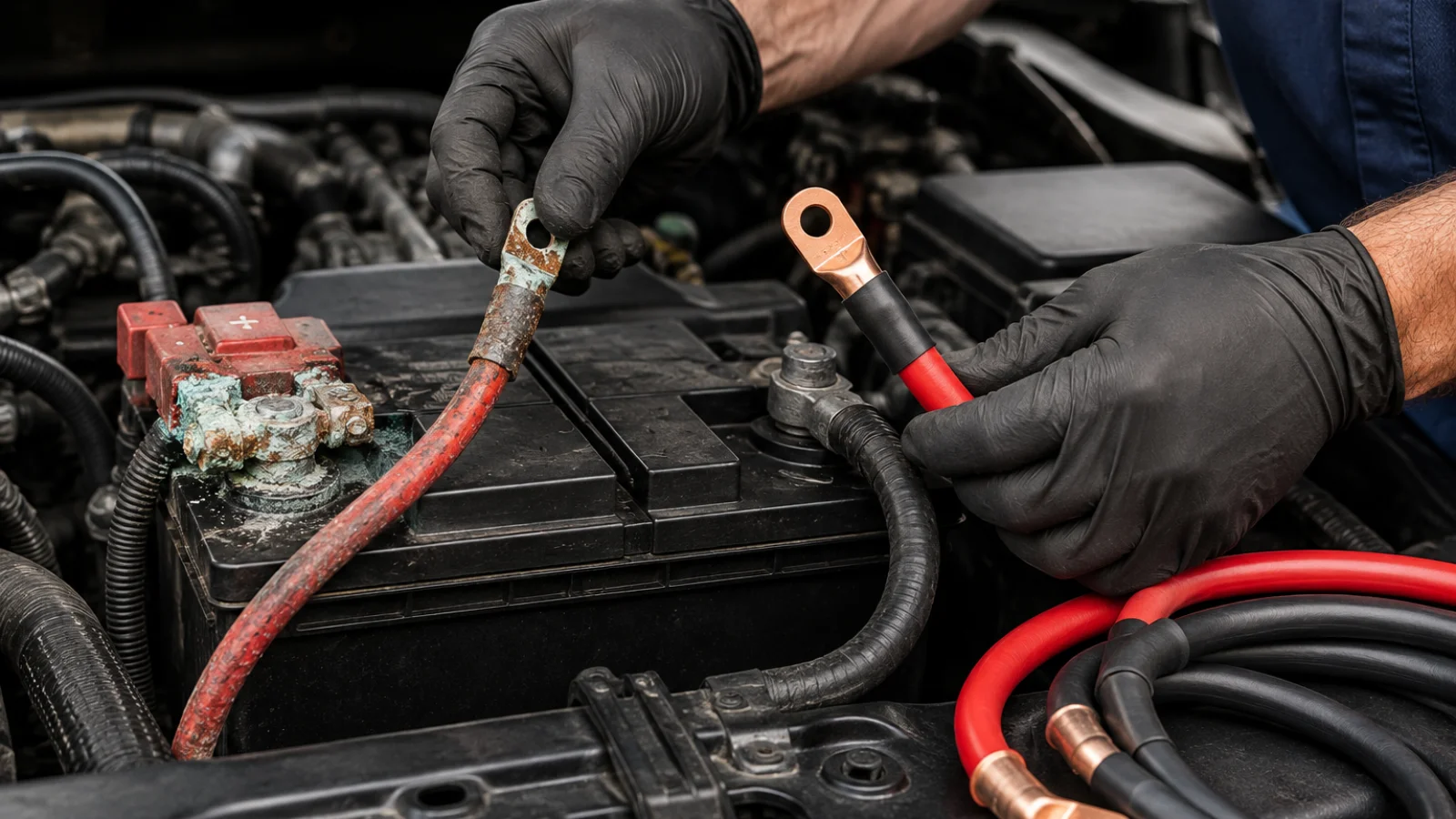
White, blue, or green buildup around the battery terminal or cable end is a warning sign.
Surface corrosion can sometimes be cleaned. But if corrosion has traveled inside the cable or the terminal is badly damaged, replacement is usually the better solution.
4. The Cable Gets Hot
A battery cable should not become unusually hot during normal starting.
Excessive resistance at a cable or connection can generate heat. If you notice heat, melted insulation, or a burning smell, stop and have the electrical system inspected.
5. The Cable Insulation Is Cracked or Damaged
Look for:
- Cracked insulation
- Frayed strands
- Melted sections
- Swollen cable ends
- Exposed conductor
- Severe corrosion
Physical damage is a strong reason to replace the cable rather than simply cleaning it.
6. Jump-Starting Doesn’t Always Work
A jump-start depends on a good electrical path.
If a cable or connection has severe resistance or an open circuit, external power may not reach the starter or vehicle electronics properly. A failed jump-start therefore does not automatically prove that the battery itself is defective.
What Causes Battery Cable Failure?
Battery cables live in a tough environment. Under the hood, they are exposed to heat, vibration, moisture, chemicals, and repeated electrical loads.
Common causes include:
- Battery acid or electrolyte contamination
- Moisture and road salt
- Corrosion
- Engine heat
- Vibration
- Loose connections
- Physical damage
- Age
- Poor-quality replacement cables
- Incorrect cable sizing
Internal corrosion can be particularly difficult to spot because the outside of the cable may still look acceptable.
How to Check Your Battery Cables
Start with a visual inspection.
Make sure the battery terminals are clean and tight. Follow the positive cable toward the starter and fuse or power distribution connections. Then inspect the negative cable and its connections to the chassis and engine.
Next, look for physical damage or corrosion.
Check for Voltage Drop
A voltage-drop test is more useful than simply looking at a cable.
Excessive resistance can cause voltage to be lost across the cable while the starter is operating. Service information commonly uses voltage-drop testing to identify excessive resistance in starter circuits.
Because testing procedures and acceptable limits vary by vehicle, use the manufacturer’s service specifications for your specific model.
Important: If you’re uncomfortable working around a high-current automotive electrical system, have a qualified technician perform the test.
Should You Replace or Upgrade Your Battery Cables?
Not every vehicle needs an upgraded cable.
If your original cables are correctly sized and in good condition, replacing them with equivalent-quality cables may be all you need.
An upgrade can make more sense when:
- The original cables are undersized for your application
- You’re installing a higher-output alternator
- The vehicle has high electrical loads
- You regularly tow
- You use a winch or auxiliary equipment
- The vehicle has an aftermarket audio system
- The original wiring has repeatedly failed
- You’re restoring an older vehicle
The goal should not simply be to install the biggest cable available. The replacement should be appropriate for the vehicle, circuit length, current demand, routing, terminals, and manufacturer requirements.
OEM vs. Heavy-Duty Battery Cables
| Feature | OEM-Equivalent Cable | Heavy-Duty Custom Cable |
| Best For | Stock vehicles | Higher-demand applications |
| Cable Size | Vehicle-specific | Application-specific |
| Construction | Standard | Heavy-duty options available |
| Custom Length | Usually limited | Available |
| High Electrical Loads | Depends on design | Better suited when correctly specified |
| Cost | Often lower | Usually higher |
| Best Value | Normal daily use | Demanding applications |
A quality OEM-equivalent replacement is often the right choice for a stock vehicle. A custom or heavy-duty cable can be useful when the vehicle’s electrical requirements exceed the original application or when you need a specific length and terminal configuration.
Real-World Example: Slow Cranking Isn’t Always the Battery
Imagine a truck owner who notices that the engine has become slower to crank.
The battery is relatively new, but the problem continues.
The owner replaces the battery. The problem improves briefly but returns.
Instead of replacing the starter next, the owner checks the battery cables. One cable has significant corrosion around the terminal and shows excessive resistance during testing.
Replacing the damaged cable restores a proper electrical path.
The lesson is simple: don’t replace expensive components before checking the connections that deliver power to them.
Replace vs. Clean: When Is Each Appropriate?
Cleaning May Be Enough When:
- Corrosion is limited to the terminal surface
- The cable itself is undamaged
- The connection can be restored securely
- Testing confirms acceptable electrical performance
Replacement Makes More Sense When:
- Corrosion has entered the cable
- The terminal is damaged
- Cable strands are broken
- Insulation is melted or cracked
- The cable has excessive resistance
- The cable repeatedly develops connection problems
If the conductor itself is compromised, cleaning the outside won’t restore the cable’s internal electrical condition.
Battery Cable Buyer Checklist
Before ordering replacement cables, confirm:
- Vehicle year, make, and model
- Engine type
- Positive or negative cable
- Required cable length
- Cable gauge
- Terminal type
- Routing requirements
- Heat exposure
- Electrical load
- Whether the vehicle is stock or modified
Don’t assume that a thicker cable is automatically better. Correct fitment and appropriate construction matter.
Expert Tip: Check the Ground
One of the easiest things to overlook is the negative side of the electrical system.
A damaged engine ground strap or poor chassis connection can cause starting and electrical problems even when the positive battery cable looks perfect.
When diagnosing a starting problem, inspect the battery-to-engine, battery-to-chassis, and engine-to-chassis grounding paths where applicable.
Common Mistakes to Avoid
Replacing the Battery First
A new battery won’t correct a high-resistance cable.
Assuming the Cable Is Good Because It Looks Good
Internal corrosion may not be visible.
Using the Wrong Cable Size
Cable size should match the electrical demand and application.
Ignoring the Negative Cable
A poor ground can create just as many problems as a damaged positive cable.
Choosing the Cheapest Replacement
The cable is part of a high-current circuit. Construction, terminals, insulation, fitment, and correct sizing all matter.
Final Verdict: When Should You Replace Your Car Battery Cables?
You should replace your car battery cables when they are physically damaged, heavily corroded, excessively resistant, overheated, or unable to provide a reliable electrical connection.
If you’re experiencing slow cranking, flickering lights, intermittent electrical problems, or repeated starting issues, don’t automatically assume the battery or alternator has failed.Check out Custom Alternator Cables USA | High Performance Power Cables
Inspect the cables and connections first.
For a normal stock vehicle, a properly sized OEM-equivalent cable may be all that’s required. For trucks, performance vehicles, high-electrical-load applications, or customized builds, heavy-duty or custom battery cables may provide a better fit for the application.
The right solution is not simply the largest cable. It’s the correct cable, correctly sized, properly terminated, and installed for the vehicle’s electrical requirements.
Ready to Replace Your Battery Cables?
If your cables are showing their age, don’t wait for a no-start situation.
Explore properly sized custom battery cables for your vehicle and choose a cable built around your specific application.
Frequently Asked Questions
How do I know if my car battery cables are bad?
Common warning signs include slow cranking, clicking during startup, dim or flickering lights, visible corrosion, damaged insulation, loose terminals, and intermittent electrical problems. These symptoms can also be caused by a weak battery, starter, alternator, or poor ground, so proper testing is important before replacing parts.
How often should car battery cables be replaced?
There is no universal replacement interval for battery cables. Their service life depends on vehicle design, climate, heat exposure, corrosion, vibration, and cable quality. Inspect them regularly and replace them when they show significant corrosion, physical damage, loose or damaged terminals, or excessive electrical resistance.
Can bad battery cables prevent a car from starting?
Yes. Severely damaged, loose, or corroded battery cables can restrict current flow between the battery and starter. This may result in slow cranking, clicking, or a complete no-start condition. A faulty cable can also interfere with power reaching other vehicle electrical systems.
Can bad battery cables damage a battery?
A cable problem does not automatically damage a battery, but poor connections can interfere with charging and starting performance. If a vehicle repeatedly experiences charging problems, the battery may be subjected to abnormal operating conditions. Diagnose the entire starting and charging system rather than replacing the battery repeatedly.
Should I replace both battery cables?
Not always. If one cable is damaged and the other is in good condition, only the affected cable may need replacement. However, if both cables are old, corroded, or showing similar deterioration, replacing them together can be a practical preventive-maintenance decision.
Is upgrading battery cables worth it?
It can be, especially for vehicles with high electrical demands, towing equipment, winches, high-output alternators, aftermarket audio systems, or modified charging systems. For a stock vehicle, a correctly sized OEM-equivalent replacement may be sufficient.
Can a battery cable look good but still be bad?
Yes. Corrosion can develop inside the insulation, and electrical resistance can increase without obvious external damage. That’s why a voltage-drop test can be useful when the symptoms suggest a cable problem but visual inspection doesn’t reveal the cause.
Why Trust Us?

Vincent Eminowicz is the Founder and Owner of Custom Battery Cables LLC. Since 2003, he has been dedicated to building high-quality custom battery cables, helping truck owners across the USA find durable, reliable electrical solutions at a fair price.
Custom Battery Cables focuses on application-specific cable construction rather than a one-size-fits-all approach. That practical experience helps customers understand the difference between simply replacing a cable and selecting the right cable for the vehicle’s actual electrical requirements.
Author: Vincent Eminowicz
Founder & Owner, Custom Battery Cables LLC