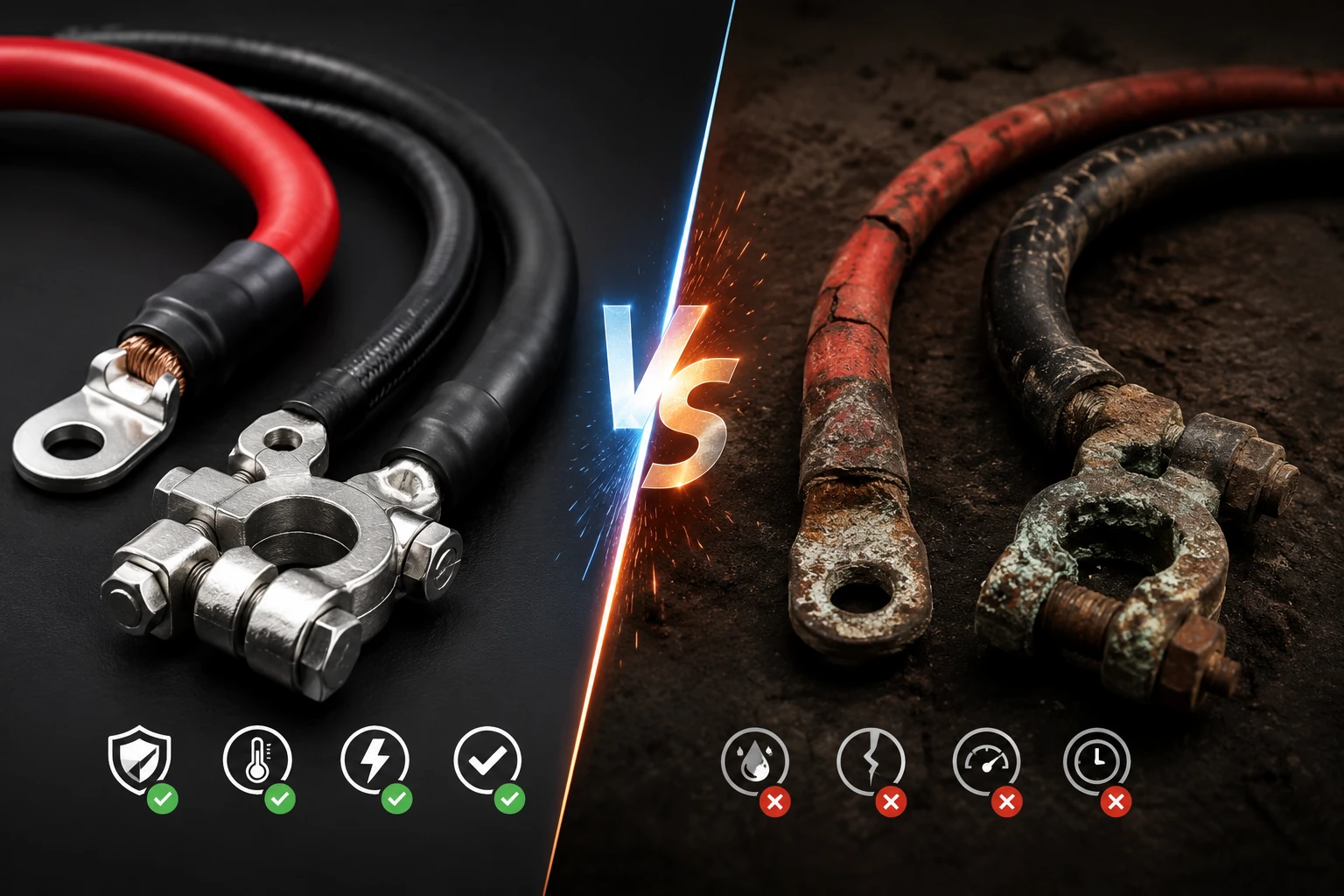
If you have ever popped your hood to chase down a hard-starting problem on your diesel truck or dug into a Jeep restoration and stared at the factory battery cables, you have probably asked yourself one honest question: are these things actually good enough?
The answer depends on what you are asking them to do. Original Equipment Manufacturer (OEM) cables are built to meet a minimum spec on a budget. Custom cables are built to meet your specific need — nothing more, nothing less, and nothing generic about them.
At Custom Battery Cables LLC in Arizona, we have spent over 20 years building made-to-order cables for everything from snowplows to show cars, Cummins-powered Dodge diesels to antique street rods. We have seen exactly what happens when the wrong cable meets a demanding application. This guide cuts through the marketing language and gives you the real-world picture.
What Is an OEM Battery Cable?
OEM stands for Original Equipment Manufacturer. These are the cables that come installed on your vehicle when it rolls off the assembly line — or the replacement cables sold at a dealership as “genuine” parts.
OEM cables are designed by engineers working within strict cost constraints. They need to meet a minimum electrical specification, survive a typical warranty period under typical use, and be cheap enough to produce at scale.
That last part matters more than most people realize. When a manufacturer is building half a million trucks a year, shaving a few cents per cable adds up to millions in savings. The wire gauge gets optimized to just barely handle the load. The connectors get stamped rather than cast. The insulation covers the basics without a lot of margin.
For a passenger car driving moderate mileage in a moderate climate, that is usually fine. For a 7.3 Powerstroke pulling a trailer in the Arizona summer heat, or a Jeep Wrangler with a lift kit, extra lights, and a winch drawing serious current, “barely enough” becomes a problem quickly.
What Makes a Custom Cable Different?
A custom cable is built from scratch to match your vehicle, your application, and your environment. Here is what that actually means in practice:
Wire Gauge Sized to Your Real Load
OEM cables are sized for stock electrical loads. The moment you add an aftermarket alternator, a high-draw winch, an inverter, or dual batteries, the stock cable is working harder than it was ever designed to. A custom cable is sized to handle what you are actually running — whether that is 1/0 AWG or 4/0 AWG stranded copper, chosen for your specific current draw.
Exact Length, No Compromises
OEM cables come in fixed lengths. On a factory vehicle, that is fine. On a vehicle with a relocated battery, a dual-battery setup, or a custom engine swap, you are either coiling up excess cable (which creates resistance and heat) or stretching a cable that is too short (which creates stress and failure points). Custom cables are cut and terminated to the exact inch you need.
Connector and Terminal Choice
Stock cables use whatever terminal style was cheapest and fastest to produce. Custom cables give you a real choice: top-post or side-post, ring lugs, Anderson connectors, quick-disconnects, fork terminals — whatever your application actually calls for. Every connection is properly crimped and heat-shrink sealed, not just clamped.
Insulation Built for Your Environment
PVC insulation is standard and serviceable. But if your engine bay runs hot, or your cables are routed near exhaust, or you need extra protection in an off-road environment, XLPE insulation with heat-shrink boots and spiral wrap or braided sleeves makes a meaningful difference in longevity. You choose the protection level. OEM cables do not give you that option.
Side-by-Side: Custom vs OEM
| Feature | OEM Cable | Custom Cable (CBC LLC) |
| Wire gauge | Minimum spec for stock load | Sized to your actual application |
| Length | Fixed factory length | Cut to your exact measurement |
| Copper quality | Varies; often partially CCA | 100% pure copper stranded wire |
| Terminals | Stamped, basic crimp | Cast, proper crimp + heat-shrink seal |
| Connector options | One type per vehicle | Ring lugs, Anderson®, clamps, quick-disconnects, more |
| Insulation | Standard PVC | PVC, XLPE, heat-shrink boots, braided sleeves |
| Color options | Black/red only | Full color-coding available |
| Application fit | Generic stock vehicle | Your specific build, year, and use case |
| Made in USA | Rarely | Yes — every cable, every time |
| Warranty support | Dealer only | Direct from the builder |
Real-World Scenarios Where Custom Wins
Diesel Trucks with Hard-Starting Problems
This is one of the most common calls we get at Custom Battery Cables LLC. A Dodge Ram 5.9 Cummins or a Ford 7.3 Powerstroke has extremely high cranking amp requirements — far higher than a gasoline engine of similar size. When battery cables develop resistance from corrosion, undersized wire, or poor crimping, you lose voltage before it ever reaches the starter. The truck cranks slowly. It barely fires in cold weather. The dealer replaces the battery, the problem comes back.
The real fix is a set of 1/0 or 2/0 AWG cables with properly terminated, fully sealed connections. We have seen trucks with years of frustrating no-start issues fixed permanently with the right cable set.
Jeep Restorations and Upgrades
A Jeep YJ, TJ, or CJ with a stock battery cable setup was never meant to run a Warn winch, LED light bars, and an upgraded stereo simultaneously. The stock cables cannot handle the combined draw. A custom cable set — sized for the full electrical load and routed cleanly for the build — handles it without voltage drop, without heat buildup, without premature failure.
Show Cars and Street Rods
Nobody wants a black rubber cable running visibly through the engine bay of a 1967 Ford Mustang restoration. Custom cables in color-matched or chrome-finished finishes, with clean braided sleeves and uniform lengths, look like they belong. OEM replacements never will.
Solar and Off-Grid Systems
Battery cables for solar installations — RVs, vans, off-grid cabins — carry serious sustained current over long runs. Undersized or low-quality cable creates resistance losses that reduce the efficiency of the entire system. Custom cables sized correctly for the run length and the charge controller amperage make the whole system perform as designed.
The “It’s Just a Cable” Myth
People sometimes treat battery cables like a commodity — interchangeable, cheap, not worth thinking about. That view collapses the moment you understand that every amp your vehicle needs has to travel through those cables without losing voltage.
Resistance in a cable creates heat. Heat degrades insulation. Degraded insulation creates shorts. Undersized wire creates voltage drop. Voltage drop starves your starter, your alternator, your electronics. None of that is dramatic until something fails — and then it is very dramatic, often at the worst possible moment.
A quality custom cable is not an upgrade for its own sake. It is the correct tool for the job your vehicle is actually doing.
Why Custom Battery Cables LLC?
We are a small Arizona-based manufacturer with one focus: building battery cables that solve real problems for real vehicles. Every cable we build is made to order in our shop. We do not stock generic cable sets and relabel them. We cut, terminate, and assemble each one to your specs.
We specialize in hard-to-find cable kits for Ford and Dodge diesel engines, Jeep Wranglers across all generations, and one-of-a-kind cables for antiques and street rods. We also build for marine, RV, golf cart, and solar applications — anything that needs reliable power delivery.
If you are not sure what you need, call us. Technical consultation is part of the service. We would rather help you order the right thing than send you a cable that does not solve your problem.
📞 (785) 422-2537 | 🌐 custombatterycables.com | 📍 Arizona, USA — Ships Nationwide
Frequently Asked Questions
Q: Are custom battery cables worth the extra cost over OEM replacements?
For stock vehicles in normal use, OEM cables are adequate. For diesel trucks with high cranking demands, vehicles with aftermarket electrical loads, off-road builds, restorations, or any application where stock cables have already caused problems — yes, custom cables are worth every dollar. The cost difference is small compared to the cost of a tow, a failed starter, or repeated no-start diagnostics.
Q: What wire gauge do I need for my diesel truck battery cables?
Most diesel applications — Ford Powerstroke, Dodge Cummins, GM Duramax — benefit from 1/0 AWG as a minimum, with 2/0 or 4/0 AWG appropriate for high-output or dual-battery setups. The right gauge depends on your cable length and your actual current draw. Contact Custom Battery Cables LLC for a free recommendation based on your specific vehicle and build.
Q: How long does it take to receive a custom cable order?
Custom Battery Cables LLC builds to order. Most orders ship within a few business days. We serve customers across Arizona and ship nationwide — lead times are typically shorter than dealer backordering OEM parts for older or specialty vehicles.
Q: Can you build cables for older vehicles where OEM replacements are no longer available?
Yes. This is one of our specialties. We regularly build cables for antique vehicles, CJ-series Jeeps, early Broncos, and street rods where factory replacement cables have been discontinued or are simply not available through normal channels. If you have measurements and terminal requirements, we can build it.
Q: What is the difference between CCA and pure copper wire in battery cables?
CCA stands for Copper-Clad Aluminum — wire with an aluminum core and a thin copper coating. It is cheaper and significantly lighter, but it has higher electrical resistance than pure copper, corrodes differently, and is not rated for the same ampacity. Custom Battery Cables LLC uses 100% pure copper stranded wire on every cable we build. For automotive and marine battery applications, pure copper is the correct material.
Q: Do you offer cables for solar and RV battery systems?
Yes. We build interconnect cables for solar battery banks, inverter/charger connections, and RV house battery systems. Proper wire sizing for these applications is critical — we can help you select the right gauge for your run length and system amperage.
Q: Where is Custom Battery Cables LLC located, and do you ship nationally?
We are based in Arizona and ship throughout the United States. We serve customers from California, Colorado, Texas, New Mexico, Nevada, and all other states. Most orders arrive within a week of placing, often faster.
Author: By Custom Battery Cables LLC — Arizona’s Premier Custom Cable Manufacturer | 20+ Years of Experience
Custom Battery Cables LLC — Made to Order, Made in the USA. Arizona-built cables for the enthusiast, the professional, and everyone who needs it done right the first time.